Terms and Conditions
Kirstin Naomie Broussard, Jovana Komnenić, Dirk Sorge
Exhibition
15.-23.11.25 Opening: 14.11.25, 16:00 Entrance free

Design: operative.space
In cooperation with Berlinklusion
With their artistic intervention Terms and Conditions, artists Kirstin Naomie Broussard, Jovana Komnenić, and Dirk Sorge question the barriers that make it difficult for both artists and audiences to access art—the “terms and conditions for public art and cultural institutions.”
Historic buildings such as the Klosterruine pose particular challenges and perspectives in this regard. In the eyes of Berlinklusion, the fact that many cultural sites are listed buildings also means that historical exclusions are preserved for the future. The three artistic works on display in the monastery ruins engage with this important architectural monument in the heart of Berlin, questioning established restrictions and the role of “gatekeepers.” On display is a mirror that reflects the outside world into the room, a sculptural clock that challenges our understanding of time, and a sandstone sculpture that illuminates the relationship between building regulations and the individual.
Berlinklusion is a network for accessibility in art and culture made up of artists, curators, and mediators with and without disabilities.
Mirror Image/You Are Here
Kirstin Naomie Broussard
Mirror Image/You Are Here by Kirstin Naomie Broussard functions as both an institutional critique and an invitation to enter and imagine an alternate reality. Mirrors are spaces of convergence where multiple points meet, they simultaneously deflect and reveal, transform and reflect reality.
The phrase “You Are Here” is similarly open ended- confronted with your reflection and pinned to a point in space you can’t physically enter, you are left to grapple with an ambiguous visual conundrum. Do you perceive yourself as inside the space, with the mirror functioning as a portal, propelling you inside, acknowledging your presence, helping you feel seen and represented? Or, aware of everything behind you doubled in your reflection, does the mirror function like a wall, offering acceptance yet perpetually placing you outside the frame?
ZUSPÄTGEKOMMEN/TARDYARRIVAL
Jovana Komnenić
Tardy Arrival
By Walter Benjamin, translated by Howard Eiland
The clock in the schoolyard wore an injured look because of my offense. It read “tardy.” And in the hall, through the classroom doors I brushed by, murmurs of secret deliberations reached my ears. Teachers and students were friends, behind those doors. Or else all was quite still, as though someone were expected. Quietly, I took hold of the door handle. Sunshine flooded the spot where I stood. Then I defiled my pristine day by entering. No one seemed to know me, or even to see me. Just as the devil takes the shadow of Peter Schlemihl, the teacher had taken my name at the beginning of the hour. I could no longer get my turn on the list. I worked noiselessly with the others until the bell sounded. But no blessedness crowned the toil.
Jovana Komnenić’s work TARDYARRIVAL refers to the concept of Crip Time—a temporality beyond normative notions of productivity and linear life courses. Its starting point is Walter Benjamin’s short text “Tardy arrival” in which the motif of being late appears not as a mere failure, but as an existential experience of alienation and invisibility. This feeling of being outside the intended rhythm becomes a symbol of structural exclusions in the cultural sphere. Not only physical but also temporal barriers—age limits, career expectations, linear educational paths—exclude those whose lives are shaped by care work, illness, migration, or interruptions. The work is a metal clock without hands, its letters, rather than numbers, forming the words “arrived too late” Installed at the side entrance to the monastery ruins, it points to alternative approaches and to “too late” as a resistant form of time.
The New Building Code
Dirk Sorge
§1: The body is a temple.
- It is maintained, renovated and repaired by the public sector.
- Use for private and commercial purposes is expressly permitted.
- If necessary, extensions are generally permitted.
- When you move out, it must be left swept clean.
§2: The mind is a construction site.
- It has been covered in an appropriate way.
- The foundation must be properly underpinned.
- It should be completely gutted and recompacted if necessary, before use.
- It must be secured against vandalism accordingly.
§3: The soul is a ruin.
- The escape and rescue routes must be kept clear at all costs.
- After a forced eviction, it is leased again.
- A wing will be demolished immediately.
- The rest is listed.
The sandstone sculpture The New Building Code by Dirk Sorge was placed as a foreign body in front of the side entrance of the former monastery near other boulders. As a test piece, it served to practice manual skills. The shape was not planned in advance, but resulted from the structure of the stone itself during chiseling. It is just as finished or unfinished as a ruin. Wind and weather can change the porous material. Any attempt to preserve the sculpture in a certain state seems futile if one thinks within geological time dimensions. The work includes a text that applies the language and terms from construction law and the real estate industry to humans. Humans are no longer seen as individuals, but only as cases for the administration, as objects or contractual partners.
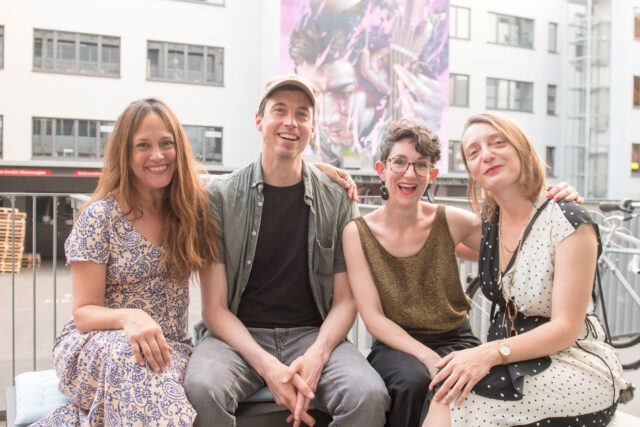
Team Berlinklusion: Kirstin Broussard, Dirk Sorge, Kate Brehme, Jovana Komnenić (from left to right), Photo: Jürgen Scheer
Biography
